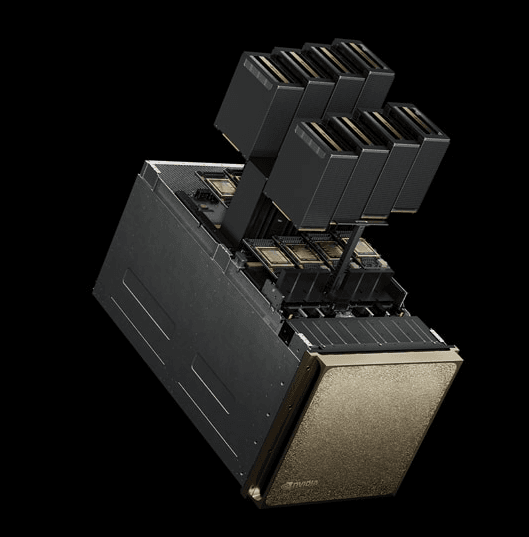
AGGX hardens GPU virtualization, parallelism, and attestation into a programmable substrate for AI. Five layers turn a fleet of heterogeneous GPUs into one elastic, verifiable, and measurable compute grid.
Not a rental marketplace with a dashboard on top — a control plane that decides where every workload runs, proves it ran correctly, and prices it by the second.
Each layer depends only on the one beneath it. That is what makes the grid portable across hardware generations — new silicon slots in at layer 01 without rewriting anything above it.
Heterogeneous GPU fleets — Blackwell, Hopper, and Ampere — wired with NVLink inside the node and InfiniBand or 800 GbE between them. Nodes are pooled into a single logical grid rather than managed as isolated clusters.
Adaptive GPU Grid Xlicing partitions each physical GPU into hardware-isolated units with their own memory ceiling, compute share, and bandwidth floor. Slices are the unit of scheduling, metering, and QoS enforcement.
A telemetry-driven control plane places work across the grid in near real time, matching each job to the topology that fits it. A policy engine enforces reservations, quotas, tenancy rules, and chargeback across teams.
04
Verification & Attestation
TEE attestationSigned usage recordsExecution auditTamper evidence
Trusted execution environments produce cryptographic proof that work ran as scheduled at full precision. Every slice emits a signed usage record you can reconcile against your own telemetry.
Optimized runtimes for training and inference sit on top: continuous batching, paged attention, quantized weights, and autoscaled endpoints — with ephemeral slices that spin up in milliseconds for bursty traffic.
Core Technologies
What we actually build
Six engineering problems sit between a rack of GPUs and a workload that runs fast, cheaply, and provably. These are the ones we work on.
01
Adaptive GPU Grid Xlicing
Partitioning that adapts to the workload, not the other way around.
Static GPU allocation wastes capacity: a 7B inference model pinned to an 80 GB card leaves most of the silicon idle. AGGX slices each GPU into hardware-isolated partitions sized to the job, then resizes the partition map as demand shifts — without evicting running work.
Memory, SM share, and interconnect bandwidth allocated per slice
Hardware-level isolation, not time-slicing — noisy neighbours cannot steal cycles
Partition maps recomputed continuously as jobs enter and leave
Per-slice QoS floors enforced at the scheduler and the driver
02
Telemetry-Driven Scheduling
Placement decisions informed by what the hardware is actually doing.
Every node streams continuous telemetry — VRAM pressure, SM occupancy, thermal headroom, NVLink and fabric saturation, matrix-multiplication throughput, and network jitter. The router trains on that stream to predict where a given job will run fastest and cheapest, then places it there.
Microsecond-level task partitioning across heterogeneous hardware
Topology-aware placement for tensor, pipeline, and data parallelism
Pre-emptive migration away from thermally throttled or degraded nodes
Reinforcement-learned routing over a Mixture-of-Experts gating network
03
Verifiable Execution
Proof that the work you paid for actually ran.
In a distributed grid, trust cannot be assumed. AGGX audits distributed workers to confirm they executed full-precision matrix operations as scheduled — catching silent downgrade to lower precision, spoofed results, and partial execution before those results reach you.
Trusted execution environments (TEEs) for attested compute
Lightweight verifier models auditing worker output at high throughput
Signed, immutable usage records per slice and per billing period
Precision-downgrade and result-manipulation detection
04
Inference Optimization
Serving models at a fraction of the naive cost.
The fastest GPU is the one you do not have to rent. Our engineering work concentrates on making models cheaper to serve — through quantization, compression, kernel-level tuning, and batching strategies that raise throughput without breaking latency targets.
Quantization across FP16, BF16, FP8, INT8, and INT4
Pruning, distillation, and structured compression pipelines
TensorRT, NVIDIA Triton, ONNX Runtime, and vLLM serving paths
Continuous batching and paged KV-cache management
05
Distributed & Multi-GPU Execution
Scaling past the memory ceiling of a single card.
Frontier models do not fit on one GPU. AGGX handles the sharding, collective communication, and failure recovery that multi-GPU and multi-node execution demand — so a 200B-parameter model behaves like a single addressable endpoint.
Tensor, pipeline, and expert parallelism across node boundaries
NCCL collective tuning matched to the physical interconnect
Checkpointing and mid-run recovery for long training jobs
Distributed inference with cross-node KV-cache coordination
06
Observability & Capacity Intelligence
Every slice is measured, priced, and explainable.
Slice-level instrumentation feeds both your dashboards and our capacity planner. The same telemetry that drives scheduling also models global GPU availability and power-cost curves, pricing capacity in real time rather than on a fixed rate card.
Nsight-grade metrics surfaced per slice, per job, per team
Bottleneck attribution: compute-bound, memory-bound, or fabric-bound
Per-second metering with reconcilable billing records
Real-time capacity and yield modelling across regions
Hardware Platform
Four generations, one scheduler
Workloads are matched to the generation that fits them. Long-context training goes to Blackwell; steady inference runs cheaper on Hopper and Ampere slices.
GPU
Architecture
Memory
Interconnect
Node Format
Status
NVIDIA B300
Blackwell Ultra
288 GB HBM3e
1.8 TB/s NVLink
HGX B300 NVL8
Q4 2026
NVIDIA B200
Blackwell
180 GB HBM3e
1.8 TB/s NVLink
HGX B200 / NVL72
Deploying
NVIDIA H100
Hopper
80 GB HBM3
900 GB/s NVLink
HGX H100 SXM
Available
NVIDIA A100
Ampere
80 GB HBM2e
600 GB/s NVLink
HGX A100 SXM
Available
High-Density Co-location
Liquid-cooled racks, redundant power, direct fabric peering
Software & Compatibility
Bring your own stack
Slices present as standard CUDA devices. If your job runs on a normal GPU today, it runs on AGGX without code changes.
Slices are enforced at the driver and firmware level. Tenants cannot read another tenant's memory, observe their utilization, or contend for their reserved bandwidth.
02Attested execution
Trusted execution environments produce a verifiable record that a workload ran on the hardware and at the precision you requested.
03Tenant-scoped networking
Each deployment runs inside its own network segment with explicit egress policy. Inter-node traffic never traverses the public internet.
04Export-control aware placement
Region and jurisdiction constraints are expressed as scheduling policy, so regulated workloads are never placed on non-compliant hardware.
Benchmark it on your own workload
We would rather show you the numbers than describe them. Send us a model and a throughput target, and we will run it on the grid and share the full profile — including where it bottlenecks.